
Think about the colleague you work with every week but know almost nothing about. You trade messages, join the same calls and nod at each other in the pantry. You know exactly how they write an email, and you have no idea whether they take their coffee strong or what they do on weekends.
Most teams are full of relationships like this. They are functional, friendly enough and quietly shallow. None of that is anyone’s fault. Work is built around tasks, not around getting to know each other, and a calendar packed with meetings leaves very little room for the in-between moments where people actually connect.
That is why so many companies turn to team building workshops, and why so many of those workshops leave people feeling like they have lost an afternoon. This post is about what really builds a stronger team, and why shared creative experiences tend to do it better than most.
Why Most Team Bonding Feels So Forced
We have all been there. Someone announces an icebreaker, and the whole room braces. You are asked to share a fun fact, stand in a circle or complete a challenge with people you barely know, all while a facilitator watches and smiles encouragingly. Everyone cooperates, because that is the polite thing to do, but nobody is fooled.
The problem is that many corporate workshops ask people to perform closeness before any closeness exists. It is a bit like being told to be friends. The activity is designed to produce a feeling, so everyone spends the session watching themselves for signs of it, and the genuine connection that might have happened gets crowded out.
Real bonding rarely comes from being told to bond. It comes from working next to someone on something that matters a little, and from seeing how they handle a small struggle.
What Changes When a Team Makes Something Together
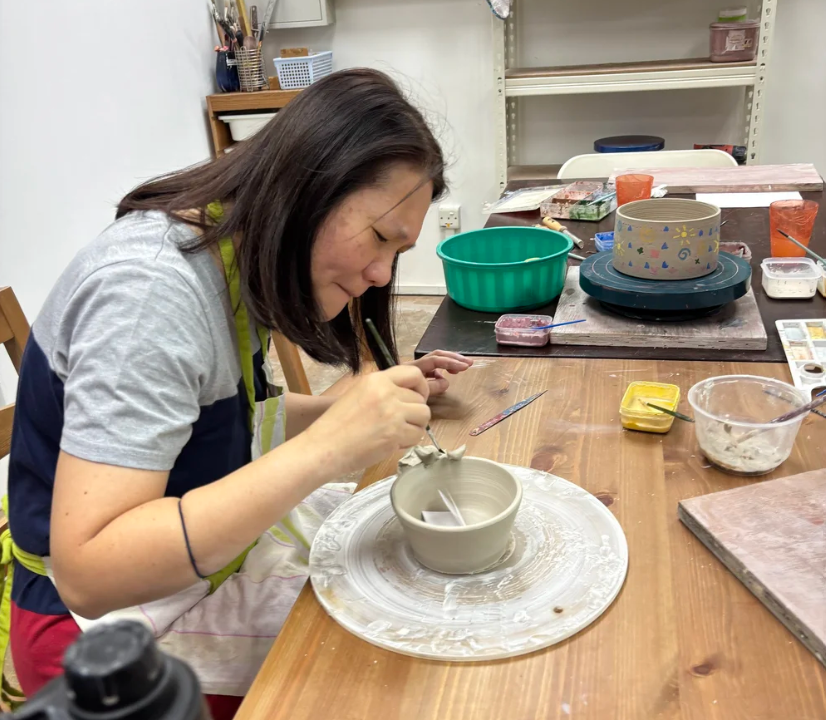
Now imagine a different kind of afternoon. Your team arrives at a studio and is handed a lump of clay. Nobody has done this before. Nobody is quite sure what to do with their hands. There is no script, only a task that is interesting enough to hold your attention.
Something shifts in the first twenty minutes. People stop watching themselves and start watching the clay. They ask the person beside them how they got a certain shape. They laugh when a piece slumps. They compare glaze ideas without being asked. The conversation that follows is the kind you never get in a conference room, because it is not about work and nobody is trying to impress anyone.
This is the quiet strength of a shared creative experience. The activity does the heavy lifting, so the people do not have to. A workshop team that is absorbed in the same task ends up bonding almost by accident, and that kind of connection tends to stick.
The Equaliser Effect
One of the most relatable things about a first-time craft is that everyone is bad at it in the same way. The senior director and the newest intern are both wrestling with the same wobbly bowl. There is no expert in the room to defer to, so the usual hierarchy loosens.
This matters more than it sounds. In an ordinary meeting, a few voices tend to dominate, and the quieter people nod along. In a studio, those same quiet colleagues are often the ones with the steadiest hands or the most unexpected ideas. A manager sees a team member lead for the first time. A team member sees their manager laugh at their own lopsided mug. People leave having seen each other from a slightly different angle.
That is what a good teamwork workshop does. It does not lecture people about collaboration. It gives them a small, shared problem and lets collaboration happen on its own.
Shared Creative Experiences in Practice
The format does not need to be complicated. In our own sessions, there are a few ways it tends to play out, depending on what a team wants from the day.
Some teams work on one big piece together. We prepare larger pots in advance, and everyone designs, colours and decorates part of it, so the finished artwork has a little of every person in it. For larger groups, preparing the forms ahead of time means people can spend their energy on designing and collaborating rather than on setup.
Other teams prefer individual pieces built around a shared theme. Every participant gets their own piece, but everyone responds to the same idea, whether that is a company value like collaboration or growth, or a theme chosen for the day. The results look completely different from one another, which becomes its own conversation. People get to see, in a very visible way, how differently a group of colleagues can interpret the same idea.
Some teams combine both, with one collaborative team piece and personal pieces to take home. Others mix techniques, trying a little wheel throwing and a little hand-building in one session. And when it suits the team better, we bring a customised hand-building workshop to their own venue instead.
The best corporate team building workshops are shaped around the group in front of us. A team of ten in a quiet season needs something different from a department of sixty after a hectic quarter.
Why It Works for Real, Busy Teams
Most teams today are stretched in some way. Some are split between home and the office, so people go weeks without being in the same room. Some have grown quickly, so half the team have never properly met. Others have just been through a reorganisation, and trust needs rebuilding.
Shared creative experiences suit all of these situations because they ask for very little in advance. Nobody needs to prepare, nobody needs to be “good at” anything, and nobody needs to pretend to be someone they are not. People simply turn up, make something and leave a little closer than they arrived.
There is also something about doing a thing in person, with your hands, that a video call cannot replicate. The shared silence while everyone concentrates, the small jokes, the moment someone holds up a finished piece and the whole table leans in to look. These are the moments that quietly rebuild a team.
What Makes a Workshop Worth Doing
If you are planning something for your own team, a few simple questions can help you tell a worthwhile session from a forgettable one.
Does it give people something real to focus on, or does it rely on forced conversation? Is it shaped around your team’s size, mood and goals, or is it a generic package? Will people leave with something tangible, like a piece they made, that keeps reminding them of the day? And is the atmosphere relaxed enough that nobody feels they are being evaluated?
If the answer to all four is yes, you are probably looking at something people will still mention weeks later. We explored the wellbeing side of this in our piece on corporate wellbeing workshops and why hands-on creativity matters, which looks at how a calmer team often turns out to be a closer one.
Making the Effect Last
The best part of a clay session is that it leaves something behind. After a piece is dried, glazed and fired, it becomes an object someone can place on a desk or a shelf at home. Months later, it is still a small prompt: that was the afternoon we all made something together.
That lingering reminder matters. Team bonding that exists only in the moment fades by the following week. A physical piece, and the story attached to it, gives people something to refer back to, and it gives teams a shared memory that has nothing to do with deadlines.
Planning One for Your Team
If you are thinking about a session for your own team, the easiest place to start is a conversation about what you are hoping to achieve. Do you want to celebrate a milestone, welcome new joiners, give a stretched team a proper break, or simply get people talking again? Each goal points toward a slightly different format.
If you would like to see how a session actually runs from start to finish, our guide to corporate pottery workshops for team building in Singapore walks through it. You can also browse more ideas and stories on our blog while you think it over.
Stronger teams are rarely built by a single big event. They are built from small shared moments, repeated, where people see each other as more than a name in a message thread. A creative afternoon is one of the simplest ways to start.
Let’s Plan Something Your Team Will Actually Enjoy
Explore the corporate workshops we design at Klay Kathaa, or get in touch and tell us about your team. We will help you shape a session that fits.
